
Let’s start with a simple number: 20%.
That’s the flat income tax rate you could legally pay in Portugal for the next 10 years. It’s not a loophole or an offshore scheme that is just waiting for a whistleblower. It is a government-designed tax incentive, baked into Portugal’s State Budget.
But the thing is, most people who should know about this great tax incentive don’t. And if you’ve heard about it, you still might not have a clear idea whether:
- It applies to you
- Your employer qualifies
- The paperwork is worth the effort
This post answers all of that and shows you exactly how we fit into the picture.
First things first: what happened to the NHR?
If you’ve spent any time researching moving to Portugal, you’ve probably come across the old Non-Habitual Residency (NHR) regime. It was wildly popular, particularly with remote workers, retirees, and digital nomads from across Europe and beyond.
It’s gone. The Portuguese State Budget for 2024 ended it for good, with a transitional window that let a final group of movers register before it closed completely.
But here’s what most articles leave out: it wasn’t just gone into the void and replaced with nothing. It was replaced with IFICI, which is a sort of NHR 2.0, more targeted than the original NHR.
What is IFICI?
IFICI stands for Incentivo Fiscal à Investigação Científica e Inovação: the Incentive for Scientific Research and Innovation -long name. We know. But the concept is simple.
IFICI is a tax regime for new residents of Portugal who work in high-value, innovation-adjacent fields. If you qualify, you pay a flat 20% income tax rate on your Portuguese-sourced income for 10 years after qualifying.
For comparison, the standard Portuguese progressive rate climbs to 48%. That’s not a small difference. Over ten years, the gap IFICI offers can be life-changing.
Ministerial Order no. 352/2024/1 regulates Portugal’s Tax Incentive for Scientific Research and Innovation (IFICI). Often referred to as “NHR 2.0”, it grants ghly skilled professionals and researchers a special 20% flat IRS rate for 10 consecutive years.
The legal framework sits under Law no. 82/2023 of December 29 (the 2024 State Budget Law), which added Article 58-A to the Tax Benefits Statute (EBF), and the Ministerial Order was later amended by Ministerial Order no. 52-A/2025/1 of February 25, 2025.
IFICI vs NHR: what changed?
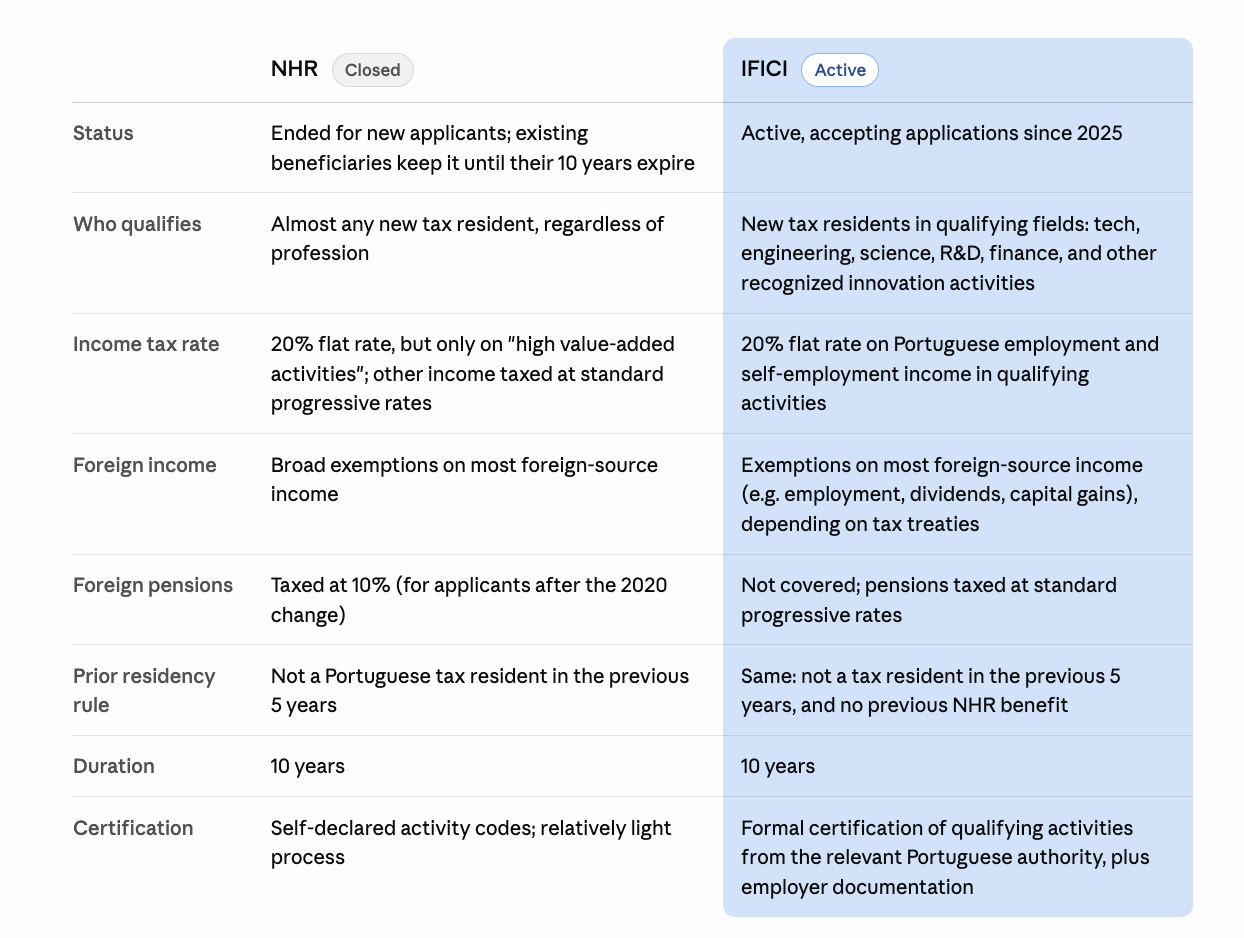
IFICI is often called “NHR 2.0”, but it’s not a copy-paste replacement. The new regime keeps the headline benefits (the 20% flat rate and the 10-year duration) while narrowing who can access them.
Here’s how they compare side by side:
Who qualifies for IFICI?
This is where a lot of articles get vague. So let’s be specific.
You need to tick three boxes:
1-You haven’t lived in Portugal in the last 5 years.
Simple residency requirement. If you’re a first-time mover, you’re fine. If you left Portugal a few years ago and are considering a return, please check the exact dates carefully.
2-You’re a tax resident in Portugal.
Either you spend more than 183 days in Portugal in a tax year, or you have a permanent home here. You can’t collect the benefit IFICI offers while living somewhere else. You need to make the move to Portugal.
3-You work in a qualifying field.
This is where people get nervous, but the list is broader than the name suggests. The official list of “highly qualified professions” (Ministerial Order no. 352/2024/1) includes:
- General and executive managers
- Administrative and commercial services managers
- Production and specialized services managers
- Experts in physical sciences, mathematics, engineering and related technics
- Industrial product and equipment designers
- Doctors
- University and higher education professors
- IT and communication specialists (TIC)
If you work in tech, you almost certainly qualify. If you’re a founder, a senior engineer, a scientist, or a data professional, the same applies. This new regime was designed to pull talent, not to create an endless bureaucratic filtering process. There’s one more condition: no outstanding tax debts with the Portuguese Tax and Customs Authority or Social Security.
What are the benefits of IFICI
The 20% flat rate is the lead. But it’s not the whole story.
Foreign income exemption
In many cases, income earned abroad is fully exempt from Portuguese tax under IFICI. This is a critical detail for remote workers, founders with international revenue, or anyone with income streams outside Portugal. The specifics depend on your situation and tax treaties between countries, so this is one to model carefully with a tax advisor (but the potential upside is significant).
No wealth tax
Portugal doesn’t have a general wealth tax. What you accumulate stays yours.
No inheritance tax between spouses and direct descendants
If you’re building generational wealth, this matters. It’s one of the cleaner aspects of the Portuguese tax system.
Duration
As mentioned earlier: 10 years. This isn’t a short-term incentive. A decade of advantaged taxation gives you time to actually build something: a business, a life, a savings base.
Cost of living
While the cost of living in Portugal isn’t a tax benefit, it compounds everything above. Lisbon and Porto remain significantly more affordable than London, Amsterdam, Zurich, or New York. Your after-tax income goes further. Plus, you get to enjoy amazing food and 300 days of sunshine per year.
What’s the catch?

There are a few things worth knowing before you get too excited. The application process is real work.
You don’t just show up in Portugal and declare yourself IFICI-eligible.
You have to apply yourself, through the Portal das Finanças and the competent entity will make the verification of the applicable requirements.
The documents required depend on your situation:
If you’re employed:
- Employment contract
- A certification from your employer that the applicable requirements relating to the activity performed are complied with
- Proof of academic qualifications
- Tax compliance certificates
If you set up your own company:
- Up-to-date company registration certificate
- Proof of academic qualifications
- Tax compliance certificates
No employer statement needed (your company registration covers that side of the equation.) In both cases, additional documents may be requested during the process. The path to IFICI runs through more than just you.
If you’re employed, notice what sits at the top of that list: your employment contract and a statement from your employer. This statement confirms that your role genuinely qualifies under IFICI. If your employer isn’t set up to support the application, or doesn’t know what it means to be an IFICI-eligible employer, you may get stuck before you’ve started.
If you’re setting up your own company, that particular hurdle disappears. But a different set of questions opens up around company structure, local registration, and ongoing compliance.
Why your employer matters more than you think
The IFICI regime isn’t just a relationship between you and the Portuguese tax authority. Your employer is a participant in the process.
They need to provide the right documentation. They need to confirm the nature of your work. They need their own registration and compliance in order. And they need to understand what they’re signing off on. Here’s where many expats hit an unexpected wall.
A lot of people moving to Portugal are still working for a foreign company based in another country. Their employer isn’t Portuguese, doesn’t have a Portuguese entity, and has never heard of IFICI. By default, they can’t provide what the regime requires, because they simply aren’t set up for it.
This is where an Employer of Record (EOR) comes in. An EOR is a local company that becomes your official employer in Portugal for legal and compliance purposes.
You keep your role, your responsibilities, and your relationship with your original company. The EOR handles the local employment structure: the contracts, the payroll, the social security, the registration. You don’t need to quit your job. You don’t need your foreign employer to set up a Portuguese entity. The EOR bridges that gap.
For IFICI specifically, this matters enormously. Because the EOR is your employer of record, they are the ones who can provide the documentation the regime requires.
This is where our team at BRIDGE IN comes in
We are an IFICI-eligible employer.
That means when you work with us, the employer side of the IFICI equation is entirely handled by us. We understand the documentation requirements. We know what the certification process looks like. We provide what you need.
You keep your position. You keep your team. You keep your relationship with your company. We sit in the background making sure the Portuguese employment side is structured correctly, compliantly, and in a way that supports your IFICI application from day one.
Payroll, contracts, local registration, compliance: that’s on us. Our job is to handle everything around employment so you can focus on managing and growing your team.
For someone thinking about a Portugal move, this is the piece that usually gets underestimated. The personal tax research is doable. But navigating a new employment structure in a new country, in a language you may not speak, under a regime that has only been in operation since 2025? That’s where people stall.
Is this right for you? An honest framework
Before you book a consultation with anyone, run yourself through this:
You’re a strong IFICI candidate if:
- You work in tech, engineering, science, or a related innovation field
- You haven’t been a Portuguese tax resident in the last five years
- You can genuinely commit to spending 183+ days a year in Portugal (or establishing a permanent home)
- Your income is primarily employment-based or self-employment in a qualifying sector
- You want 10 years of tax stability, not a year-by-year gamble
You’ll need more due diligence if:
- Your income comes primarily from investments, pensions, or passive sources (IFICI is activity-based)
- You have complex international tax situations across multiple jurisdictions
- Your field doesn’t clearly fall into the qualifying categories (though this is rarer than people assume)
The questions worth asking a professional:
- How does IFICI interact with my home country’s tax treaty with Portugal?
- Does my specific role qualify under the current list of recognized activities?
- What does the foreign income exemption actually cover in my case?
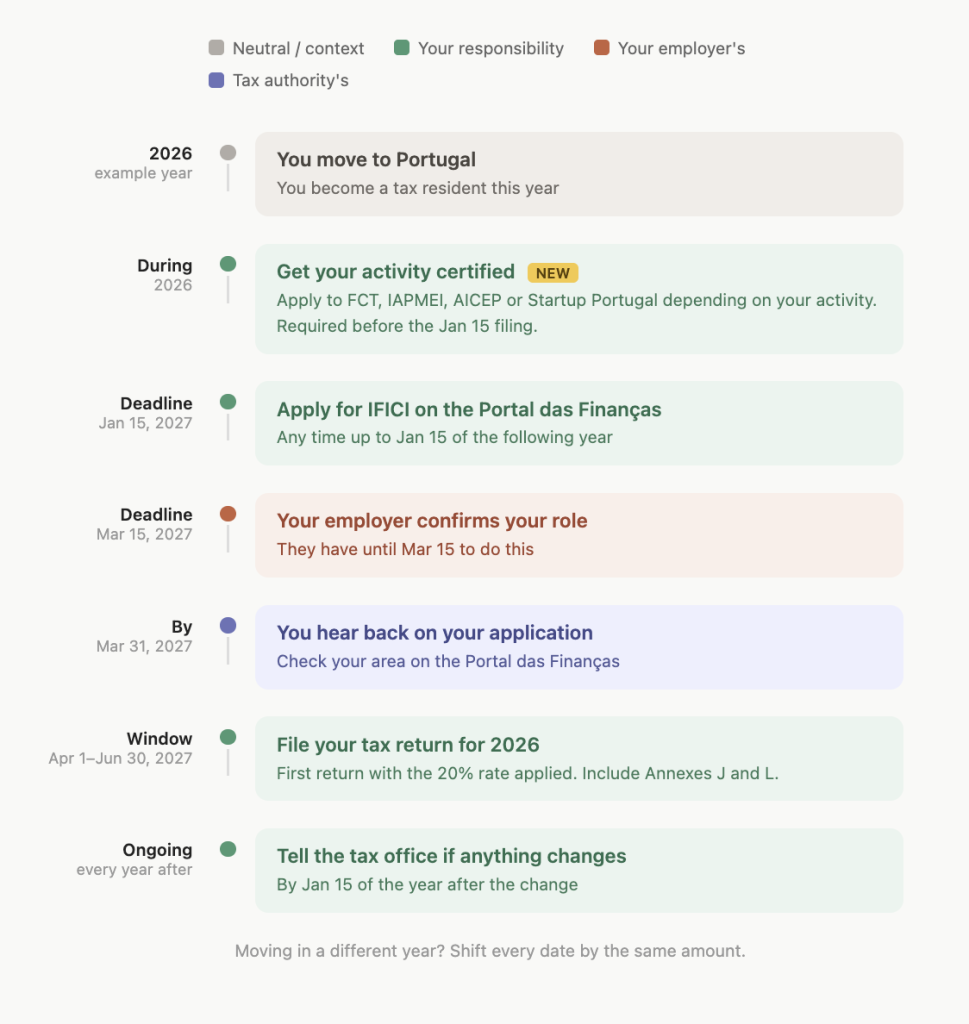
Key IFICI deadlines to consider
Ready to understand what IFICI to EOR looks like for your specific situation?
We offer free consultations. No commitment, no pitch deck, and definitely no pressure.
Bring your questions and your scepticism. We’ll walk through your situation honestly and tell you whether this is something worth pursuing. If it is, we will discuss what the process actually looks like with us as your employer.